2 Timothy 3:16 16 All Scripture is God-breathed and profitable for teaching, for reproof, for correction, for training in righteousness, 17 so that the man of God may be equipped, having been thoroughly equipped for every good work.
2 Peter 1:21 21 For no prophecy was ever made by the will of man, but men being moved by the Holy Spirit spoke from God.
Psalm 12:6 The words of Yahweh are pure words; as silver tried in a furnace on the ground, refined seven times.
Proverbs 30:5 Every word of God is tested; He is a shield to those who take refuge in Him.
John 17:17 17 Sanctify them by the truth; Your word is truth.
These words were put to paper by: a student of Paul, 2 disciples of Jesus Christ, and the 2nd and 3rd kings of Israel after it became a nation. Aside from King Solomon who did not follow YHWH as closely in his old age as he had in his youth, they all served YHWH faithfully. At least two of them were martyred. It is believed the Apostle Peter was crucified up-side-down because he didn’t feel worthy to face the same method of execution as his Savior. While the Apostle John was not martyred, his execution was attempted by boiling him in oil, but YHWH protected him from death. Later in life, he was exiled to the Isle of Patmos where YHWH gave him the Revelation which became the last book in our Bible.
Now, consider some of the miracles that are recorded in the Bible:
- Creation week.
- Enoch going to heaven without dying
- Noah and his family being saved in the flood.
- The burning bush
- The 10 plagues
- Passover
- Parting of the red sea.
That’s just the Old Testament, and it’s only a few of those found there. It is estimated the entire Bible contains between 120 and 150 miracles. Ask yourselves—did these miracles really happen, or are they just a bunch of fairytales with no relevance whatsoever to the world today?
I trust everyone here today knows they are not fairytales; they are historical accounts preserved by YHWH using faithful men, so that believers living today would have them for teaching, reproof, correction, and training in righteousness.
If YHWH is capable of performing those miracles, it should be a piece of cake for Him to preserve the history of humanity in a book and keep it free of errors for thousands of years.
So how is then when we have this wonderful book, really written as instruction for us by YHWH Himself, that Jesus has been reduced from the mighty, kingly Savior of mankind, one who is quoted as saying “I have not come to bring peace, but a sword” into a man whose sole purpose today seems to be that of one who came only to teach us how to love one another. And make no mistake, He did do that.
This is how He has taught me.
So far.
The initials with which I was born were JLS which had I thought about them might have also been an initialism for Jesus Loves Some. For most of the years those were my initials, that is what I believed. This might also describe a follower of John Calvin.
Is that what the Bible, The Word of God says? John 3:16 is possibly the most quoted verse in the Bible. It begins with these words “For God so loved the world. . . “ Was He speaking of planet earth? Was His love reserved for something that was not human? God loved planet earth so much that He gave His only begotten Son to save it?
Of course not.
We know that this world on which we reside will ultimately be destroyed and replaced with a new one.
He was talking about that which was His greatest creation.
People.
And, according to John 3:16, God didn’t just love some people—He loved all people.
When I married my first husband, my initials became JLT which had I thought about it at that time might have stood for Jesus Loves Them. That is how I felt for a large part of the time that those were my initials. He might love me, but there were others He loved more. Much more. And I certainly didn’t know what to do with those six verses in John’s gospel where he wrote about being the disciple that Jesus loved. Surely some scribe or translator somewhere in the last 2000 years had messed up and John didn’t really say or write that!
When I married Rod, my initials became JLM. A few years after we married, and after I’d survived a cancer battle which probably should have taken me out, I, or rather YHWH showed me, that those were an initialism for Jesus Loves Me. And eventually, even that he loves me best!
That isn’t arrogance, and it wasn’t arrogance when John believed it and wrote it down about himself. If you are a disciple of Jesus, you are not a disciple that Jesus loves; you are the disciple that Jesus loves. No translation error! This Truth is so important that YHWH had John record it 6 times—in 13:23, 19:26, 20:2, 21:7, and 21:20.
Very recently, just within the past couple of weeks, I realized YHWH didn’t give me those initials until I was able to wear them and believe them at the same time.
So does this not then provide proof that those who are called progressive Christians are right? Jesus is synonymous with love and, in fact is love, and that is all that needs to be considered. All the other laws and information in the Bible are just there for our entertainment; they are nothing more than fairytales and have no relevance in today’s world.
As Paul would say, “Heaven forbid!”.
When one truly has Jesus in their heart and is following the path He lays out before them, one should be becoming more like Him—but none of us IS God. His love is so incomprehensible to us mere humans that it can take a lifetime of getting to know Him to understand that we will never understand how each person He loves is the person that Jesus loves. John had something of a rudimentary understanding of this, I’m beginning to as well, and my prayer is that you will begin to get this, too.
So why did YHWH put all that other stuff in His Word? The overarcing theme of this Book is love, but what about all those little details included that don’t seem to have anything to do with love?
Going back to one of the focus Scriptures from today, notice again the words “16 All Scripture is God-breathed and profitable for teaching, for reproof, for correction, for training in righteousness, 17 so that the man of God may be equipped, having been thoroughly equipped for every good work.”
It does not say “Only the words in red are God-breathed”; it does not say “Only the words which align with your own personal moral compass are God-breathed”; and it certainly doesn’t say “Only the words which line up with today’s culture and beliefs about justice are God-breathed.”
Every single word in this book is God breathed. Every single word in this book is helpful for us because it teaches us, reproves us, corrects us, and trains us in righteousness so that we will be not just adequately equipped but fully equipped for every good work.
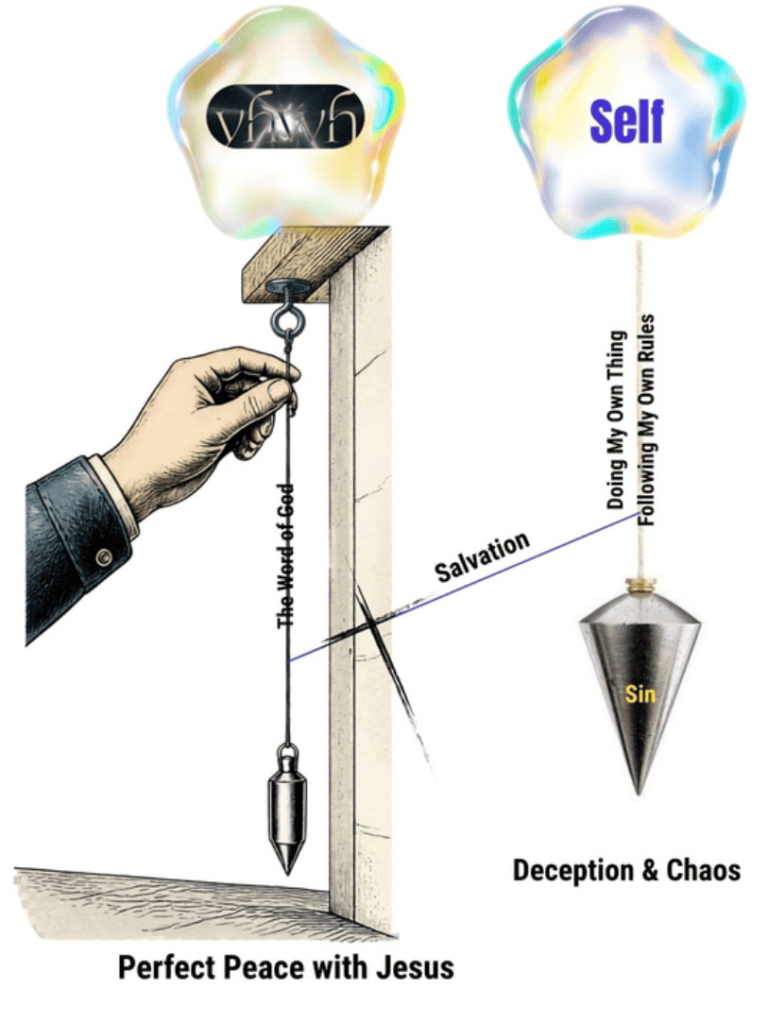
In a perfect world, like the garden in which Adam and Eve spent the beginning of their lives, there is a direct line going from us to YHWH. When sin and self-love entered the world (Eve wanted to have the same knowledge as YHWH) a new corrupted plumb line came into existence and was completely separate from the path our lives were supposed to follow. It still exists today and is the line which every human being is unknowingly following. It is a line that leads to death.
YHWH was not taken by surprise when the new line formed, and He already had a plan in place for our salvation. His Son. Self-sacrifice is the purest form of love, and that’s exactly what YHWH did. He made a way for the plumb line corrupted by sin to be rejoined to the plumb line leading back to Him. That Way is available to all. Then once you’re in the right line, The Word of God is the way to peace.
Now, what happens when a person goes back and forth from the True plumb line to that which is corrupt?
You could get a pretty serious tangle.
If you’re a believer and not well acquainted with His word, how can your life be anything but tangled and chaotic? How can it not be scary, especially when you look with your physical senses at the downright evil that is occurring on a daily basis? Living with your heart twisted is no way to live.
Follow the True plumb line. (Hold up Bible)
Stay the course.
I love that line from the Mel Gibson movie “The Patriot.”
You are alive here in the land of the living. You are doing your best to be a faithful follower of YHWH. The best help for “staying the course” is found within these pages, your True plumb line. Don’t get tangled up by returned over and over to the corrupt one. Jesus is love, yes, and this is His instruction on how to more fully know and express that love.
Abba, as Paul wrote in 1 Corithians “I do all things for the sake of the gospel, so that I may become a fellow partaker of it and that in running my race, I will win the prize, that of everlasting life with You.” And that I, the one to whom You gave the initials JLM, can persuade as many others as is within my power to do of the same. I pray that each of those beloved individuals will get to hear those most precious words “Well done, good and faithful servant.” at the conclusion of his or her race.
 Feel free to use this as a study guide the next time your reading takes you to this part of the Bible.