Plumb Lines

2 Timothy 3:16 16 All Scripture is God-breathed and profitable for teaching, for reproof, for correction, for training in righteousness, 17 so that the man of God may be equipped, having been thoroughly equipped for every good work.

2 Peter 1:21 21 For no prophecy was ever made by the will of man, but men being moved by the Holy Spirit spoke from God.

Psalm 12:6 The words of Yahweh are pure words; as silver tried in a furnace on the ground, refined seven times.

Proverbs 30:5 Every word of God is tested; He is a shield to those who take refuge in Him.

John 17:17 17 Sanctify them by the truth; Your word is truth.

These words were put to paper by: a student of Paul, 2 disciples of Jesus Christ, and the 2nd and 3rd kings of Israel after it became a nation. Aside from King Solomon who did not follow YHWH as closely in his old age as he had in his youth, they all served YHWH faithfully. At least two of them were martyred. It is believed the Apostle Peter was crucified up-side-down because he didn’t feel worthy to face the same method of execution as his Savior. While the Apostle John was not martyred, his execution was attempted by boiling him in oil, but YHWH protected him from death. Later in life, he was exiled to the Isle of Patmos where YHWH gave him the Revelation which became the last book in our Bible.

Now, consider some of the miracles that are recorded in the Bible:

  1. Creation week.
  2. Enoch going to heaven without dying
  3. Noah and his family being saved in the flood.
  4. The burning bush
  5. The 10 plagues
  6. Passover
  7. Parting of the red sea.

That’s just the Old Testament, and it’s only a few of those found there. It is estimated the entire Bible contains between 120 and 150 miracles. Ask yourselves—did these miracles really happen, or are they just a bunch of fairytales with no relevance whatsoever to the world today?

I trust everyone here today knows they are not fairytales; they are historical accounts preserved by YHWH using faithful men, so that believers living today would have them for teaching, reproof, correction, and training in righteousness.

If YHWH is capable of performing those miracles, it should be a piece of cake for Him to preserve the history of humanity in a book and keep it free of errors for thousands of years.

So how is then when we have this wonderful book, really written as instruction for us by YHWH Himself, that Jesus has been reduced from the mighty, kingly Savior of mankind, one who is quoted as saying “I have not come to bring peace, but a sword” into a man whose sole purpose today seems to be that of one who came only to teach us how to love one another. And make no mistake, He did do that.

This is how He has taught me.

So far.

The initials with which I was born were JLS which had I thought about them might have also been an initialism for  Jesus Loves Some. For most of the years those were my initials, that is what I believed. This might also describe a follower of John Calvin.

Is that what the Bible, The Word of God says? John 3:16 is possibly the most quoted verse in the Bible. It begins with these words “For God so loved the world. . . “ Was He speaking of planet earth? Was His love reserved for something that was not human? God loved planet earth so much that He gave His only begotten Son to save it?

Of course not.

We know that this world on which we reside will ultimately be destroyed and replaced with a new one.

He was talking about that which was His greatest creation.

People.

And, according to John 3:16, God didn’t just love some people—He loved all people.

When I married my first husband, my initials became JLT which had I thought about it at that time might have stood for Jesus Loves Them. That is how I felt for a large part of the time that those were my initials. He might love me, but there were others He loved more. Much more. And I certainly didn’t know what to do with those six verses in John’s gospel where he wrote about being the disciple that Jesus loved. Surely some scribe or translator somewhere in the last 2000 years had messed up and John didn’t really say or write that!

When I married Rod, my initials became JLM. A few years after we married, and after I’d survived a cancer battle which probably should have taken me out, I, or rather YHWH showed me, that those were an initialism for Jesus Loves Me. And eventually, even that he loves me best!

That isn’t arrogance, and it wasn’t arrogance when John believed it and wrote it down about himself. If you are a disciple of Jesus, you are not a disciple that Jesus loves; you are the disciple that Jesus loves. No translation error! This Truth is so important that YHWH had John record it 6 times—in 13:23, 19:26, 20:2, 21:7, and 21:20.

Very recently, just within the past couple of weeks, I realized  YHWH didn’t give me those initials until I was able to wear them and believe them at the same time.

So does this not then provide proof that those who are called progressive Christians are right? Jesus is synonymous with love and, in fact is love, and that is all that needs to be considered. All the other laws and information in the Bible are just there for our entertainment; they are nothing more than fairytales and have no relevance in today’s world.

As Paul would say, “Heaven forbid!”.

When one truly has Jesus in their heart and is following the path He lays out before them, one should be becoming more like Him—but none of us IS God. His love is so incomprehensible to us mere humans that it can take a lifetime of getting to know Him to understand that we will never understand how each person He loves is the person that Jesus loves. John had something of a rudimentary understanding of this, I’m beginning to as well, and my prayer is that you will begin to get this, too.

So why did YHWH put all that other stuff in His Word? The overarcing theme of this Book is love, but what about all those little details included that don’t seem to have anything to do with love?

Going back to one of the focus Scriptures from today, notice again the words “16 All Scripture is God-breathed and profitable for teaching, for reproof, for correction, for training in righteousness, 17 so that the man of God may be equipped, having been thoroughly equipped for every good work.”

It does not say “Only the words in red are God-breathed”; it does not say “Only the words which align with your own personal moral compass are God-breathed”; and it certainly doesn’t say “Only the words which line up with today’s culture and beliefs about justice are God-breathed.”

Every single word in this book is God breathed. Every single word in this book is helpful for us because it teaches us, reproves us, corrects us, and trains us in righteousness so that we will be not just adequately equipped but fully equipped for every good work.
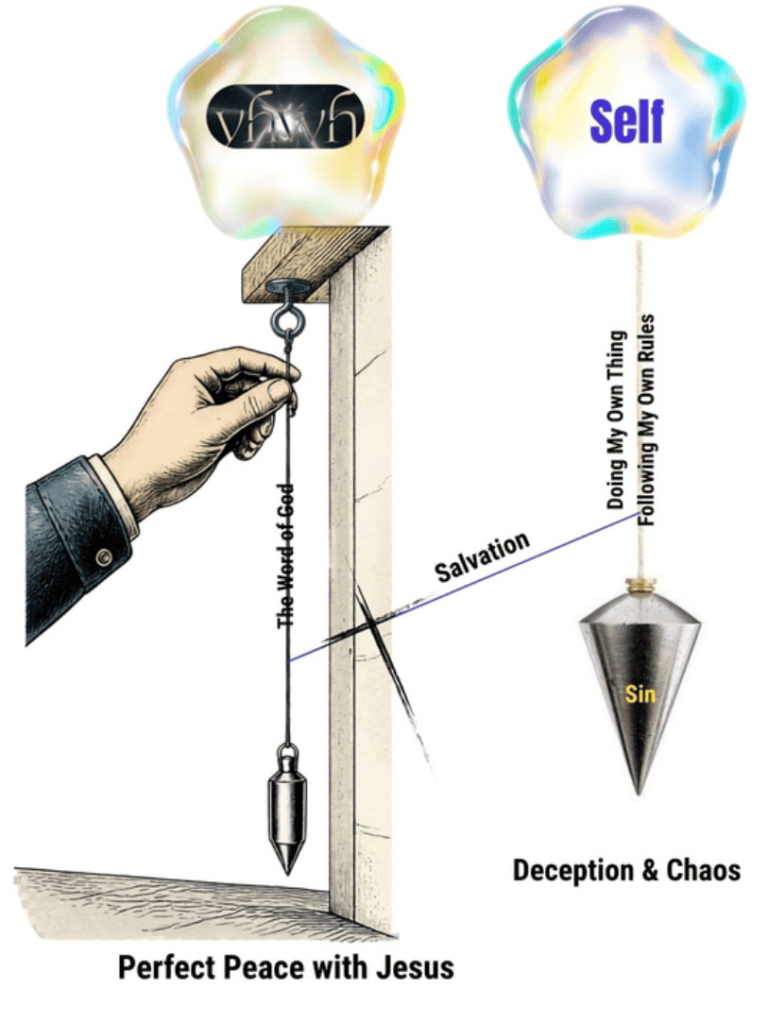
In a perfect world, like the garden in which Adam and Eve spent the beginning of their lives, there is a direct line going from us to YHWH. When sin and self-love entered the world (Eve wanted to have the same knowledge as YHWH) a new corrupted plumb line came into existence and was completely separate from the path our lives were supposed to follow. It still exists today and is the line which every human being is unknowingly following. It is a line that leads to death.

YHWH was not taken by surprise when the new line formed, and He already had a plan in place for our salvation. His Son. Self-sacrifice is the purest form of love, and that’s exactly what YHWH did. He made a way for the plumb line corrupted by sin to be rejoined to the plumb line leading back to Him. That Way is available to all. Then once you’re in the right line, The Word of God is the way to peace.

Now, what happens when a person goes back and forth from the True plumb line to that which is corrupt?

You could get a pretty serious tangle.

If you’re a believer and not well acquainted with His word, how can your life be anything but tangled and chaotic? How can it not be scary, especially when you look with your physical senses at the downright evil that is occurring on a daily basis? Living with your heart twisted is no way to live.

Follow the True plumb line. (Hold up Bible)

Stay the course.

I love that line from the Mel Gibson movie “The Patriot.”

You are alive here in the land of the living. You are doing your best to be a faithful follower of YHWH. The best help for “staying the course” is found within these pages, your True plumb line. Don’t get tangled up by returned over and over to the corrupt one. Jesus is love, yes, and this is His instruction on how to more fully know and express that love.

Abba, as Paul wrote in 1 Corithians “I do all things for the sake of the gospel, so that I may become a fellow partaker of it and that in running my race, I will win the prize, that of everlasting life with You.” And that I, the one to whom You gave the initials JLM, can persuade as many others as is within my power to do of the same. I pray that each of those beloved individuals will get to hear those most precious words “Well done, good and faithful servant.” at the conclusion of his or her race.  

How Do You Pray?

How Do You Pray?

Jeremiah 33:3 Call to Me, and I will answer and show you great and unsearchable things you do not know.

James 4:1-6 1What causes conflicts and quarrels among you? Don’t they come from the passions at war within you? 2You crave what you do not have; you kill and covet, but are unable to obtain it. You quarrel and fight. You do not have, because you do not ask. 3And when you do ask, you do not receive, because you ask with wrong motives, that you may squander it on your pleasures.

4You adulteresses! Do you not know that friendship with the world is hostility toward God? Therefore, whoever chooses to be a friend of the world renders himself an enemy of God. 5Or do you think the Scripture says without reason that the Spirit He caused to dwell in us yearns with envy? 6But He gives us more grace. This is why it says: “God opposes the proud, but gives grace to the humble.”

1 Thessalonians 5:17 “Pray without ceasing.”

Last week our pastor spoke about prayer, the Lord’s prayer, in particular, illustrating this as a great template for how to format our prayers and reminding us with his sermon title (To Whom Do You Pray?) the identity of the One to Whom we pray.

We all have need of our daily bread being given, our trespasses being forgiven, and freedom from temptation and evil. But what about those other needs? Things like healing, financial assistance, family problems, and a myriad of other things seemingly not addressed in the Lord’s prayer.

The Bible gives many examples of people praying for things they needed and or/wanted. Today’s scripture references show us why we should pray.

Wouldn’t you like to see great and unsearchable things you don’t already know, as Jeremiah promises?

I doubt anyone reading this is a killer, but certainly we have all coveted from time to time. And, we have all quarreled or fought with someone in our lifetime. Those are things that our human selves cause us to do when the things we want or think we need are not readily available.

The next verse tells us we don’t have because we don’t ask AND our motives are wrong, we want to “squander” our answered prayers on earthly things.

What follows is an example of what I believe was a wrong prayer prayed by a “good person” that, to which for some reason, YHWH said yes.

I’ll preface this by reminding you that the northern kingdom of Israel had no “good” kings, and the southern kingdom of Judah had only 8 of its 20 kings who were considered good.

One of those was Hezekiah. 2 Chronicles 31:20-21 says that Hezekiah was “good and upright and true before the Lord his God. 21He was diligent in every work that he began in the service of the house of God, and in the law and the commandments, in order to seek his God. And so he prospered.”

Later historically in a parallel history of the nation of Judah located in 1 and 2 Kings, in 2 Kings chapter 20 we find that In those days Hezekiah became mortally ill. The prophet Isaiah, the same one who wrote the book of Isaiah “son of Amoz came to him and said, “This is what the Lord says: ‘Put your house in order, for you are about to die; you will not recover.’” It sounds as though his death was imminent.

2 Kings goes on: 2Then Hezekiah turned his face to the wall and prayed to the Lord, saying, 3“Please, O Lord, remember how I have walked before You faithfully and with wholehearted devotion; I have done what was good in Your sight.” And Hezekiah wept bitterly.

4Before Isaiah had left the middle courtyard, the word of the Lord came to him, saying, 5“Go back and tell Hezekiah the leader of My people that this is what the Lord, the God of your father David, says: ‘I have heard your prayer; I have seen your tears. I will surely heal you. On the third day from now you will go up to the house of the Lord. 6I will add fifteen years to your life.

Did YHWH “change his mind”?

Numbers 23:19 “God is not a man, that He should lie, or a son of man, that He should change His mind. Does He speak and not act? Does He promise and not fulfill?”

Yet, there are many instances where it “seems” like YHWH has changed his mind, including the one just described about Hezekiah.

In fact, this “changing” of YHWH’s mind resulted in the birth of one of the most evil kings in Judah’s lineup of kings. In addition, due to pride in self and the blessings which YHWH had bestowed upon him, just a few verses later in the same chapter verses 12-13 “At that time Merodach-baladan son of Baladan king of Babylon sent letters and a gift to Hezekiah, for he had heard about Hezekiah’s illness. And Hezekiah received the envoys and showed them all that was in his treasure house—the silver, the gold, the spices, and the precious oil, as well as his armory—all that was found in his storehouses. There was nothing in his palace or in all his dominion that Hezekiah did not show them.” Note, it was the king of Babylon to whom Hezekiah showed “his” treasures. The same Babylon who a few years later took the nation of Israel into captivity.

Trustworthy prophet of YHWH, Isaiah, was still in King Hezekiah’s corner, and he rebuked him, with the remainder of the verses of this chapter reading as follows: Then the prophet Isaiah went to King Hezekiah and asked, “Where did those men come from, and what did they say to you?”

“They came from a distant land,” Hezekiah replied, “from Babylon.”

“What have they seen in your palace?” Isaiah asked.

“They have seen everything in my palace,” answered Hezekiah. “There is nothing among my treasures that I did not show them.”

Then Isaiah said to Hezekiah, “Hear the word of the Lord: The time will surely come when everything in your palace and all that your fathers have stored up until this day will be carried off to Babylon. Nothing will be left, says the Lord. And some of your descendants, your own flesh and blood, will be taken away to be eunuchs in the palace of the king of Babylon.”

But Hezekiah said to Isaiah, “The word of the Lord that you have spoken is good.” For he thought, “Will there not at least be peace and security in my lifetime?”

So Hezekiah repented, but no other great kingly acts are recorded about him as chapter 20 concludes with these final 2 verses:

As for the rest of the acts of Hezekiah, along with all his might and how he constructed the pool and the tunnel to bring water into the city, are they not written in the Book of the Chronicles of the Kings of Judah? And Hezekiah rested with his fathers, and his son Manasseh reigned in his place.

And there it, the 4th word from the end “Manasseh.”

His evil acts are described in the next chapter of 2 Kings beginning with verse 2 “he did evil in the sight of the Lord by following the abominations of the nations that the Lord had driven out before the Israelites.”

Continuing with verse 3 “he rebuilt the high places that his father Hezekiah had destroyed, and he raised up altars for Baal. He made an Asherah pole, as King Ahab of Israel had done, and he worshiped and served all the host of heaven.”

And in verse 6 “He sacrificed his own son in the fire, practiced sorcery and divination, and consulted mediums and spiritists. He did great evil in the sight of the Lord, provoking Him to anger.” In my humble opinion, the act of “sacrificing a child to the fire” for personal gain and/or comfort is not any different than the act of abortion.

For these reasons and others, Manasseh earned the title of “the most evil king in Judah’s history”.

However. . . and this is a big however. . . in the parallel version found in 2 Chronicles 33, Manasseh was captured and tortured by a foreign entity.

While in captivity, in what was probably the lowest point of his life in verse 12 “in his distress, Manasseh sought the favor of the Lord his God and earnestly humbled himself before the God of his fathers.”

And verse 13 “the Lord received his plea and heard his petition; so He brought him back to Jerusalem and to his kingdom. Then Manasseh knew that the Lord is God.”

Manasseh’s life as relayed by 2 Chronicles concludes with verses 18-20 “As for the rest of the acts of Manasseh, along with his prayer to his God and the words of the seers who spoke to him in the name of the Lord, the God of Israel, they are indeed written in the Chronicles of the Kings of Israel. His prayer and how God received his plea, as well as all his sin and unfaithfulness, and the sites where he built high places and set up Asherah poles and idols before he humbled himself, they are indeed written in the Records of the Seers. And Manasseh rested with his fathers and was buried at his palace. And his son Amon reigned in his place.”

Because of YHWH’s grace, and Manasseh’s humility before Him, Manasseh concluded his life as a “good” king, and I fully expect to meet him in Heaven one day.

Romans 8:28 “we know that God works all things together for the good of those who love Him, who are called according to His purpose.”

Because of Manasseh’s repentance and YHWH’s grace and mercy, his son Amon was born who was an evil king, but Amon’s son, Josiah was the most godly king Judah had in the entirety of its history. Josiah’s story can be found in 2 Kings 22 through 2 Kings 23:30 and 2 Chronicles 34 and 35.

All of them, Hezekiah, Manasseh, Amon, and Josiah are in the Lord Jesus’ lineage!

So, while Hezekiah’s prayer may have produced some bad things, in the end it all worked according to YHWH’s purposes and for the good of those who love Him.

So. . . returning to our original scripture in James, look at that last verse, verse 6 “He gives us more grace. This is why it says: “God opposes the proud, but gives grace to the humble.”

Hezekiah’s pride hurt him and, indeed, his people. . . but when he humbled himself even though his motives may not have been 100% pure, he received grace. Manasseh also received grace.

WE RECEIVE GRACE.

Prayer is simply us maintaining our relationship with the One Who loves us the most. It doesn’t have to and, in fact, shouldn’t be filled with lofty words we don’t even fully understand. It doesn’t have to be lengthy. Listen to these words from Matthew 6 in the passage just before the Lord’s Prayer “And when you pray, do not be like the hypocrites. For they love to pray standing in the synagogues and on the street corners to be seen by men. Truly I tell you, they already have their full reward.

But when you pray, go into your inner room, shut your door, and pray to your Father, who is unseen. And your Father, who sees what is done in secret, will reward you.

And when you pray, do not babble on like pagans, for they think that by their many words they will be heard.

Do not be like them, for your Father knows what you need before you ask Him.“

That is not to say you should not ever pray in public. 1 Thessalonians 5:17 says “Pray without ceasing.” It is also suggested you look up the verse immediately preceding that one. Undoubtedly, some of the times you are praying, you will be in a public setting. But remember, although prayer in its most basic form is carrying on a conversation with YHWH, it should always be done in humility and worship of YHWH remembering His kingdom, His power, and His glory which will last throughout eternity.

Hiding God’s Word in Your Heart

How proficient are you at doing this?

I must confess, I wish I were better at memorization. I have the 23rd Psalm, The Lord’s Prayer, John 3:16, 1 Corinthians 6:19-20 (but I just looked that one up to make sure I had the right verses), and Romans 12:2 memorized. That is a very short list considering I’ve been walking with Yeshua 48 years now. . . and. . . I’ve heard of those who have entire books of the Bible memorized!

Is memorization the definition of hiding the Word of God in your heart?

It’s certainly one of the ways.

There are other Bible passages I can generally find easily including Psalm 139, Genesis 6, Romans 8, Psalm 91, Psalm 116. There are still others that my mind is learning to know the location of such as Luke 12:51-53.

Internet search engines have made it possible for me to look up any thought that pops into my head, particularly when preparing something to share here or in a sermon, or in any other writing, before presenting it to anyone else, and it is easy to confirm the thought’s veracity with the Word of God.

I do not know that memorization is necessary on this day, February 8, 2026, in the United States; but considering the season in history in which we live and the fact many of us—and if not us, certainly our descendants—may see a time when Bibles are not permissible, it would be a sign of wisdom to use memorization to hide the Word in one’s heart.

Shalom shalom.

The Wonder of Chesed

I gave serious consideration to titling this “IS LOVE LOVE?” which is a rearrangement of words of a phrase currently in common use. The thing about love is. . . it comes from many different words, some Greek, one Latin. Here are 9 of them.

  • Agápe brotherly love, charity; the love of God for person and of person for God. Agape is used in ancient texts to denote feelings for one’s children and the feelings for a spouse, and it was also used to refer to a love feast. In a couple months, I will be participating in a love feast when I take another Walk to Emmaus, this time working in the room that is called the Agape Chapel. It is a room where every one of the 50+ participants in a Walk to Emmaus retreat goes to be prayed over at one or more points during the weekend. There are usually 3-4 workers there who spend the entire 3 days praying, sometimes even staying overnight in the chapel praying when no one else is around. Sunday afternoon, following the closing ceremony every follower of Jesus leaves will a full serving of agape on board.
  • Éros love is romantic passion or love of the human body. This is the love that will be celebrated on Wednesday. It is also the cause of much sin.
  • Philia means affectionate regard, friendship, usually “between equals”. Philadelphia is called the city of brotherly love.
  • Storge means “love, affection especially of parents and children”. It is the common or natural empathy, like that felt by parents for offspring. I believe it is also a supernaturally augmented by God, and I certainly experienced it myself upon the birth of each of my children.
  • Philautia means “self-love”. To love oneself has been conceptualized both as a basic human necessity and as a moral flaw, akin to vanity and selfishness. We are instructed in the Bible to love our neighbors as ourselves (Mt 22:37-39). If we do not have love for ourself as a masterpiece of our great creator (Ps 139:14), what sort of love would we be giving our neighbor?
  • Xenia  describes the concept of hospitality, “guest-friendship”, or “ritualized friendship”.

Dictionary.com adds in

  • Mania is an obsessive love such as the type of love a stalker feels toward his/her victim.

And

  • Pragma is love based on duty, obligation, or logic

Those are all Greek words. In addition, there is the Latin word

  • Ludus means playful love. This could be likened to children at play. I think it is also the type of love being felt when one expresses a profound appreciation of something; i.e., I love chesed.

Truly love is not love. There’s more to it than that.

Agape love is, of course, the love most closely resembling that of YHWH toward us. But if you think about some of the original words for love, storge and even mania could be aspects of His feeling toward us. Mania? Really. Look at Psalm 23:6, Ezekiel 34:11 and Rev 3:20.

I don’t quote all the scriptures here; please look them up. Maybe one of them will become so relevant to you at your current stage in life that you will return to it again and again inadvertently memorizing it without even realizing you are doing so.

There have been several verses over the course of my life of serving YHWH that have been life changing. They don’t even necessarily include passages such as the 23rd Psalm, the Lord’s Prayer, or even John 3:16 although that one is our faith-defining verse. Here are some verses that have been life altering for me during different seasons of my life.

2 Timothy 1:7

1 Corinthians 6:19-20

Jonah 2:8

Zephaniah 3:17

The one I’m using a lot right now is Romans 12:2

Each of these reads a bit differently in the translations I most enjoy. For example, the NASB translation of Jonah 2:8: “Those who are followers of worthless idols abandon their faithfulness.” I mean, that’s good, right? But it wouldn’t have necessarily leapt off the page at me in that translation. Now the OJB version: “They that observe lying vanities forsake their own chesed.”

Wow!

The word chesed is a Hebrew word which could also mean love, but really means so much more than that.

When I first read that verse, this is the picture my mind created.

That is, of course, not the type of vanity YHWH was speaking of when he gave Jonah these words. But I think it fits. The reflection you see looking in the mirror is the same image the world sees. It is chesed, though, that tells the truth, not vanity, not this vanity and not the vanities Jonah speaks of which translate into worthless idols. It is not even love or at least some of its forms.

For a more complete picture of the original meaning of Jonah 2:8, please visit https://claudemariottini.com/2010/03/16/forsaking-their-%E2%80%9Chesed%E2%80%9D/ written by Claude Mariottini. It provides one of the best explanations of chesed (sometimes spelled with an “h” instead of a “ch”) I’ve read AND will explain why I think chesed is a superior word to love.

When you are comparing Bible translations, you should always do so under guidance of Holy Spirit. Here’s one good reason.

Recently I came across the following on FB posted by a renowned worship leader I follow. “With my whole heart, with my whole life, and with my innermost being, I bow in wonder and love before you, the holy God! YAHWEH, you are my soul’s celebration. How could I ever forget the miracles of kindness you’ve done for me? You kissed my heart with forgiveness, in spite of all I’ve done. You’ve healed me inside and out from every disease. You’ve rescued me from hell and saved my life. You’ve crowned me with love and mercy. You satisfy my every desire with good things. You’ve supercharged my life so that I soar again like a flying eagle in the sky!”

Surely she was citing the words to one of the worship songs she wrote. Then I discovered that was not the case. She was quoting Psalm 103:1-5. I LOVED (ludus, anyone?) it, but having read the Psalms many times, I didn’t recall ever reading those words there. Then I saw the translation she was using. The Passion Translation.

This has been in past years one of my favorites, and I used it frequently in sermons.

However, in 2022 Bible Gateway, which I also use a lot, made the decision to remove The Passion Translation from its list of 90 English translations/paraphrases. The Living Bible and The Message, both of which are considered paraphrases rather than translations, are still present on Bible Gateway. When I was a teenager I received something called “The Way” as a gift from my parents. It’s the New Testament, Psalms, and Proverbs in the Living Bible which was at the time considered a translation. Not relevant, but don’t the 2 guys on the bottom look like Kevin Tighe and Randolph Mantooth from Emergency?

The difference between a translation and a paraphrase?

I couldn’t really find a reasonable explanation on a google search, but this is what I believe which may or not be correct. A translation takes the original text and translates it into the English language (or the language of the reader) using the same words. A paraphrase takes the original text and rewrites it to convey the presumed meaning of the original text. This makes the rendering of the paraphrase open to the interpretation of the one who compiles it. . . and. . . it may not completely reflect YHWH’s thoughts. Bible Gateway deems that both the Living Bible and The Message are acceptable but not The Passion Translation. Why?

The gist of the reasoning behind this seems to be that

  1. The Passion Translation’s creator maintains it is a translation rather than a paraphrase.
  2. He states his intention in its creation was to quote “expand the essential meaning of the original language by highlighting the essence of God’s original message” endquote.

Do not those 2 things contradict one another?

So, in recent years I’ve been using TPT as a devotional rather than the Word of God. Devotionals are helpful in gaining a better understanding of God and His Word. Devotionals are not the Word of God.

Here is another example of TPT text.

“Pray like this: ‘Our Beloved Father, dwelling in the heavenly realms, may the glory of your name be the center on which our lives turn. Manifest your kingdom realm, and cause your every purpose to be fulfilled on earth, just as it is in heaven. We acknowledge you as our Provider of all we need each day. Forgive us the wrongs we have done as we ourselves release forgiveness to those who have wronged us. Rescue us every time we face tribulation and set us free from evil. For you are the King who rules with power and glory forever. Amen.’”

Did you recognize those words?


They are the Passion Translation version of the Lord’s Prayer found in Matthew 6:9-13. One phrase does not appear in any form in the version of The Lord’s Prayer we use which comes from the Book of Common Prayer and most closely resembles the words found in the New Matthew Bible (that’s a new one for me that I need to check out) translation. Nor does this phrase appear in any other Bible translation.

“Rescue us from every tribulation.”

This illustrates a possible explanation for why Bible Gateway no longer provides TPT in any of its 90 Bible translations/paraphrases. One only has to look at the situations faced by Christians in other countries, particularly 3rd world countries, to see that God does not always “rescue us from tribulation”.

Clearly, there are a lot of Bibles out there, especially in America. If you are a Christian, Holy Spirit lives within you; but is He leading you? He will not steer you wrong regarding the Word of God. I don’t believe He has steered me wrong in choosing chesed over love.

These 3 human beings, all Valentine’s babies, showed me chesed to the best of their abilities:

On the left is my father-in-law by my first marriage, in the middle is my wonderful Rod, and on the right is my Grandma Stauffer who died when I was 7 years old. Now they are members of the great cloud of witnesses (Hebrews 12:1-2) cheering me on.

On Wednesday, when you think about the day that we celebrate, remember the word chesed and that it not only means the versions of love that we could attribute to YHWH but it includes mercy, grace, faithfulness, true loyalty, commitment, covenant, and even the Creator, YHWH Himself. There is capital T Truth to the statement God is chesed and, therefore, chesed is chesed; and it is truly wonderful.

Shalom.

4 Dimensional YHWH

Yesterday, during my coaching call with my Revelation Within coach, we discussed YHWH’s 4 dimensionality

I had heard this discussed recently by, I believed at the time, one of my favorite podcasters (my favorite outside Heidi and Christina) that God is 4 dimensional, but we humans live in a 3-dimensional world; that’s a big part of the dichotomy we experience. Thinking about it, though, I believe instead of Brant Hanson it might have been my current favorite preacher from whom I heard this tidbit of wisdom. He may have shared the verse, but I didn’t write it down and didn’t remember it.

Yesterday, Christina and I visited Romans 8:38-39 which is similar but not exactly the same.

This morning, when I opened my HIStory Bible, my reading was in Ephesians 4. This is what I read: verse 16 really jumped out at me “that He would GRANT YOU, ACCORDING TO THE RICHES OF HIS GLORY, TO BE STRENGTHENED WITH POWER THROUGH HIS SPIRIT IN THE INNER SELF, so that Christ may dwell in your hearts through faith, and that you , being rooted and grounded in love may be able to comprehend with all the saints what is THE WIDTH AND HEIGHT AND LENGTH AND DEPTH , and to know the love of Christ which SURPASES KNOWLEDGE that you may be filled to all the goodness of God.” Every word is great, but I’ve capped the ones that are especially relevant to me.

I love how YHWH knows my thoughts, those I speak and those I don’t. He is such a personal, intimate, knowing bridegroom (knowing surpasses knowledge). And I’m so glad the Bible doesn’t call Him a husband, rather a bridegroom, the one who stands at the front of the church as you enter and His eyes nearly pop out of His head and a big grin appears on His face when he first sees you in all your bridal attire. Not the one with whom you have “words” over the children, the bills, the house, etc.